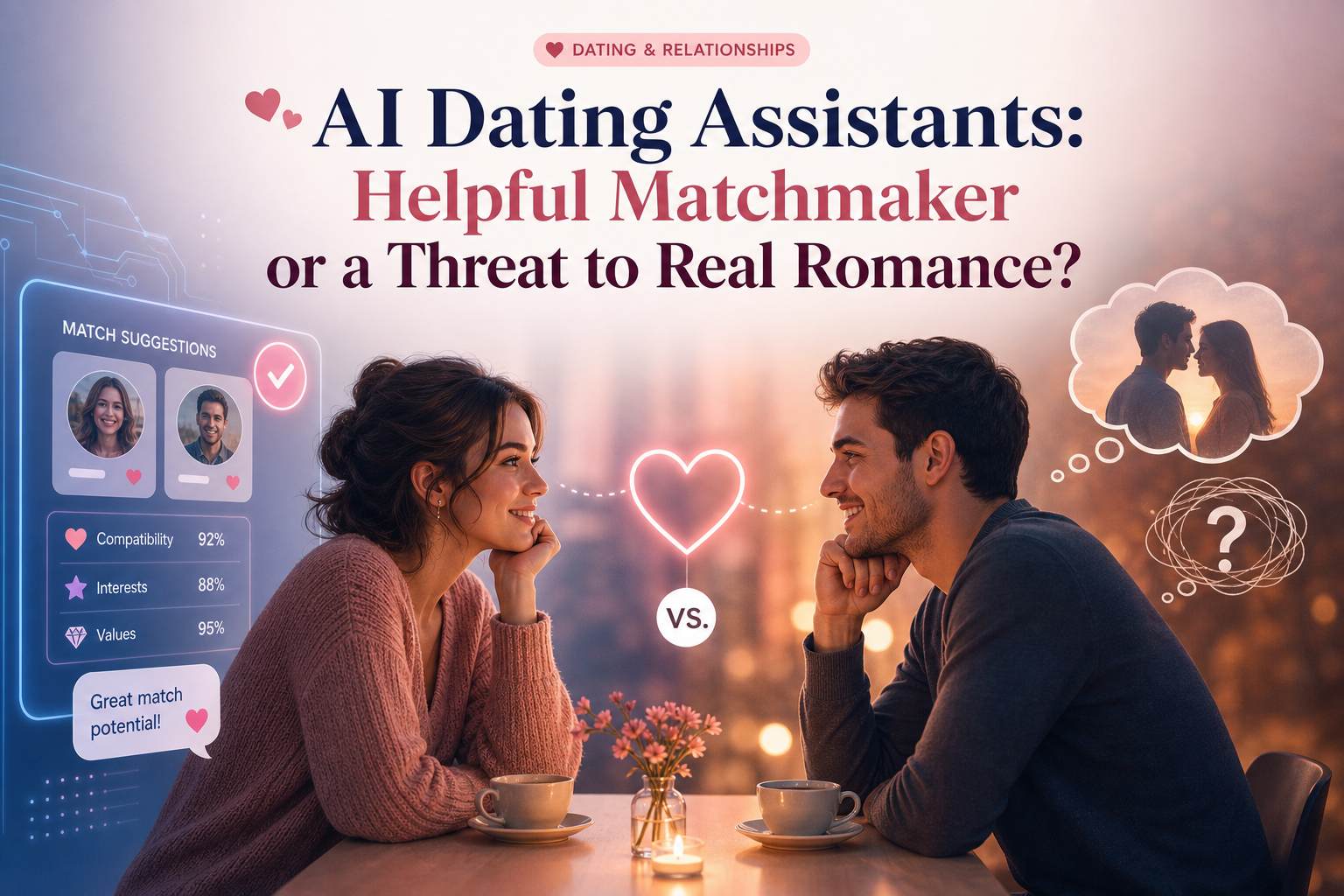
You match with someone interesting. She sends a message that is warm, funny, and just personal enough to make you pause. You want to reply well—but not too eagerly, not too formally, and certainly not like every other man in her inbox.
So you ask an AI dating assistant for help.
Seconds later, it suggests a polished response. The conversation continues. But then a more uncomfortable question appears: Is she getting to know you—or the version of you generated by a machine?
AI is already influencing online dating in several ways: writing profile prompts, improving photos, suggesting opening lines, screening matches, translating messages, and helping people decide when to move from chat to a date. Used carefully, these tools can reduce friction and help a nervous dater communicate more clearly. Used carelessly, they can turn romantic conversation into a performance neither person fully created.
The real issue is not whether AI belongs in dating. It is where assistance ends and impersonation begins.
Table of Contents
ToggleWhat AI dating assistants actually do
“AI dating assistant” can mean several different things. Some tools are built into dating apps; others are separate chatbots or browser extensions. Their functions usually fall into five categories:
- Profile help: rewriting a bio, choosing prompts, or making a description more specific.
- Photo feedback: suggesting which pictures communicate warmth, confidence, or lifestyle.
- Message suggestions: creating an opener or helping respond to a difficult message.
- Conversation analysis: identifying possible red flags, mixed signals, or signs of low interest.
- Matchmaking support: recommending compatible profiles or helping organize preferences.
These uses are not equally risky. Asking AI to correct awkward grammar in your profile is very different from sending AI-generated messages throughout a six-week courtship.
A useful rule is simple:
The more personal, emotional, and consequential the message, the more it should come from you.
AI can help you express yourself. It should not quietly become the person the other dater thinks she is building a connection with.
Where an AI dating assistant can genuinely help
1. It can improve a weak profile without inventing a personality
Many dating profiles fail because they are vague:
- “I like to have fun.”
- “Looking for someone genuine.”
- “I work hard and play hard.”
- “Ask me anything.”
An AI tool can point out that these lines give a match almost nothing to respond to. It can turn general statements into conversation-friendly details.
For example:
Before:
“I enjoy traveling, good food, and staying active.”
After:
“I’m happiest discovering small restaurants, taking long walks in unfamiliar cities, and pretending my weekend cycling routes are not mostly uphill.”
The second version is more useful because it offers texture and an opening. But you still need to check that it sounds like you. If you have never cycled farther than the local park, do not publish a profile that suggests otherwise simply because it reads well.
Best use: ask AI for three variations, then rewrite the final version yourself.
2. It can help when nerves make you overthink
Some men do not struggle with interest; they struggle with editing every sentence until the conversation feels like a job application.
An AI assistant can act as a second pair of eyes. You can ask:
- “Does this message sound too intense?”
- “Is this response defensive?”
- “Can you make this clearer without making it flirtier?”
- “What question could naturally follow this topic?”
That can be particularly useful after a misunderstanding. Instead of firing off a long explanation, you can use AI to identify the main point and remove unnecessary defensiveness.
The key is to use it for clarity, not for manufacturing charm.
3. It can help people who communicate in a second language
Dating across languages can create unnecessary problems. A person may have a strong sense of humor or emotional intelligence but struggle to express both in a new language.
Translation and rewriting tools can help preserve meaning and avoid accidental bluntness. Still, literal fluency is not the same as cultural fluency. A perfectly translated message may sound unnatural or overly formal.
A better process is:
- Write what you genuinely mean.
- Ask for help making it natural in the other language.
- Read the result carefully.
- Remove expressions you would never use in real life.
Your match should meet a real person who speaks imperfectly—not a perfectly polished corporate communications department.
4. It can help identify patterns you are too close to see
An AI conversation analyzer may notice that you repeatedly:
- ask questions without revealing anything about yourself;
- turn every topic sexual;
- complain about previous dates;
- apologize excessively;
- continue chasing after minimal replies;
- avoid suggesting an actual date.
This kind of feedback can be useful if treated as a prompt for reflection rather than an objective verdict.
AI cannot reliably know someone’s intentions from a few messages. A short answer may mean disinterest, busyness, caution, or simply a different texting style. Use analysis to generate questions—not to issue confident diagnoses.
When AI starts damaging romantic trust
The appeal of automation is obvious: fewer awkward moments, faster replies, and a greater sense of control. But romance depends on information that automation can quietly distort.
The other person is responding to a constructed version of you
If every message is generated, edited, and optimized, your match may believe you are more witty, emotionally articulate, available, or confident than you really are.
That does not mean every assisted message is dishonest. People already ask friends for advice, draft texts, and revise what they want to say. The problem is scale. If AI handles the substance, tone, timing, and emotional labor of the conversation, your match is no longer experiencing your communication style.
This creates a predictable moment of disappointment when you meet in person or speak on the phone. The conversation suddenly becomes slower, less polished, and less effortless.
That is not necessarily bad—real conversations are often imperfect. But the contrast can feel like a bait-and-switch.
Automated charm can make several conversations sound identical
AI tends to favor messages that are upbeat, emotionally intelligent, and broadly appealing. Used repeatedly, it can produce a recognizable sameness:
- “That sounds like such a meaningful experience.”
- “I love that you’re passionate about…”
- “You seem like someone who values…”
- “What’s something that always makes you smile?”
These lines are not offensive. They are simply generic when sent without real curiosity behind them.
A better opening refers to something concrete:
“You mentioned moving to Lisbon for six months. Was that a planned adventure or an escape from a bad office job?”
It is specific, slightly playful, and gives the other person something real to answer. You do not need an algorithm to notice the most interesting detail on her profile.
Emotional messages should not be outsourced
Some messages carry consequences that go beyond wording:
- apologizing after an argument;
- responding to vulnerability;
- ending a connection;
- discussing exclusivity;
- expressing romantic interest;
- rejecting someone respectfully;
- addressing sexual boundaries.
AI can help you organize your thoughts, but it should not decide what you feel or deliver a fake emotional response.
If someone tells you she is anxious about dating after a painful relationship, replying with an AI-generated paragraph about “creating a safe and supportive space” may sound considerate while avoiding the human task of actually listening.
When the message matters, write a rough version yourself first. You can edit for clarity afterward, but keep the core feeling and responsibility yours.
The privacy problem: what are you uploading?
Dating conversations often contain sensitive information: names, workplaces, locations, health details, family situations, sexual preferences, photographs, and private disclosures. Pasting that material into an AI service may expose more than you intended.
Before using an AI dating tool, check:
- What data does it store?
- Is your information used to improve the service?
- Can human reviewers access submitted content?
- Does the tool connect to your dating account?
- What permissions does it request?
- Can you delete your data?
- Does it require your match’s messages or photos?
Avoid uploading identifiable private conversations whenever possible. Remove names, workplaces, phone numbers, exact locations, and other details that are not needed for the question.
For example, instead of pasting:
“Sarah from the marketing team at Northbridge, who lives on Oak Street…”
write:
“A woman I matched with said she is cautious about dating after a difficult breakup. I want to respond supportively without sounding like a therapist. What should I consider?”
You can usually get useful guidance without turning another person’s private life into training material for a third-party service.
Helpful assistant or deceptive ghostwriter? Use this test
Ask yourself three questions before sending an AI-assisted message.
1. Could I say this naturally in a live conversation?
If the answer is no, the message is too polished, too dramatic, or simply not yours.
2. Am I hiding the use of AI because it would change her decision to continue?
This is not a demand to announce every grammar correction. But if you are using AI to generate nearly every meaningful message, your secrecy is revealing. You probably understand that the other person would consider the behavior relevant.
3. Does the message communicate my actual view?
AI often fills gaps with assumptions. It may make you sound more enthusiastic than you are, more emotionally available than you feel, or more certain about the relationship than the situation supports.
If the answer to any question is no, rewrite the message manually.
A practical way to use AI without losing yourself
You do not have to choose between total automation and refusing all technology. A balanced approach separates support tasks from identity tasks.
| Use AI for support | Keep human |
|---|---|
| Correcting grammar | Deciding what you feel |
| Suggesting profile details | Choosing what is true about you |
| Finding a less awkward phrasing | Sharing vulnerable information |
| Translating a message | Apologizing and taking responsibility |
| Identifying possible conversation topics | Creating genuine curiosity |
| Spotting patterns in your dating habits | Judging compatibility |
| Organizing questions before a date | Making the final decision |
A five-step workflow for messaging
- Write your own draft first.
Do not begin with a prompt asking AI to “write the perfect reply.” Start with what you actually want to say. - Ask for a narrow type of help.
Try: “Make this clearer and slightly warmer, but keep my casual tone.” Avoid vague requests such as “make me sound irresistible.” - Remove anything you would not say.
Delete phrases that feel too smooth, too intense, or unlike your vocabulary. - Add one personal detail.
Mention something you genuinely noticed, experienced, or want to ask. - Send it without endless optimization.
A conversation is not a marketing campaign. Minor awkwardness is evidence of a real person, not a defect.
Signs you may be relying on AI too much
A tool has probably crossed the line from assistance to substitution if:
- you cannot reply without consulting it;
- you use the same generated style with every match;
- you avoid phone calls because your real-time communication feels weaker;
- you have created a persona more attractive than your actual life;
- you receive compliments for being emotionally insightful but do not feel connected;
- you are maintaining conversations you would not know how to continue yourself;
- you feel anxious about the other person discovering your process;
- your messages sound impressive but do not lead to meaningful dates.
Try a simple experiment: have one conversation for a week without AI-generated wording. You may discover that the exchange becomes less polished but more revealing. That is valuable information. Dating is not only about maximizing matches; it is about finding out who communicates well with you when no one is editing the interaction.
How to recognize AI-generated messages from a match
You cannot know with certainty from style alone, and false accusations can damage a promising connection. Still, some patterns may justify caution:
- unusually polished replies that never answer your specific question;
- emotional language that sounds impressive but remains vague;
- sudden changes in vocabulary or tone;
- instant, lengthy responses at every hour;
- repeated phrases that could apply to anyone;
- enthusiastic messages followed by poor memory of what you discussed;
- difficulty moving from text to a spontaneous call.
Do not treat one polished message as proof of deception. Look for consistency over time. If the conversation feels strangely frictionless, ask a natural follow-up or suggest a brief phone call. Real compatibility usually becomes clearer when communication is less scripted.
If you suspect a match is using AI, avoid turning the interaction into an interrogation. You can say:
“Your messages are very polished. Do you use writing tools when you text? I’m fine with help for grammar, but I prefer getting to know the person directly.”
Her response may tell you more than the technology itself. A straightforward answer is different from defensiveness, evasion, or an inability to communicate without a tool.
Common mistakes men make with AI dating tools
Asking for manipulation instead of communication
Prompts such as “How do I make her chase me?” or “What is the perfect psychological reply?” frame dating as control. They may produce tactics, but tactics are poor foundations for trust.
Ask instead:
- “How can I express interest without putting pressure on her?”
- “How do I respond if her replies have become shorter?”
- “How can I invite her on a date clearly and respectfully?”
Treating AI as a lie detector
No chatbot can reliably determine whether a match is a scammer, avoidant, dishonest, or secretly interested based only on a message exchange.
Use ordinary safety practices: do not send money, protect personal information, verify identity before becoming deeply invested, and meet in a public place. Technology can support judgment; it cannot replace it.
Optimizing for replies instead of compatibility
A clever line can win attention from someone who is not a good match. The goal is not to maximize response rates at any cost. It is to create enough honesty and curiosity for the right people to recognize you.
Sometimes the most useful AI-generated advice is the least flattering: stop sending another message, clarify your intentions, or accept that the conversation has run its course.
Staying in the chat stage forever
AI can make messaging feel productive even when nothing is developing. If the conversation is comfortable and there is mutual interest, suggest a low-pressure meeting or call rather than endlessly refining texts.
For example:
“I’ve enjoyed this conversation. Would you be up for coffee this week? I’m free Thursday or Saturday afternoon.”
Clear, specific, and human beats another carefully engineered paragraph.
FAQ
Is it dishonest to use AI for dating messages?
Not automatically. Grammar correction, translation, brainstorming, and light editing are generally different from outsourcing your personality and emotions. The ethical line is crossed when AI creates a false impression of who you are or what you feel.
Should I tell a match that I used AI?
You do not need to announce every spelling correction. However, if AI generated most of your meaningful messages, disclosure becomes more relevant. A useful standard is whether the person would reasonably feel misled if she discovered how much of the conversation was automated.
Can AI help me find a compatible partner?
It can help organize preferences, identify conversation topics, and reduce some of the work involved in online dating. It cannot reliably measure chemistry, integrity, emotional availability, or how two people behave together in real life.
What is the safest way to use an AI dating assistant?
Use it for editing, reflection, translation, and preparation. Avoid sharing unnecessary personal data, do not upload private photos or conversations without considering consent, and keep emotionally important messages in your own words.
Should I stop using AI altogether?
Probably not, unless it is making you less honest, less confident, or less capable of communicating without it. The goal is not technological purity. The goal is to ensure that the person who appears in the chat is recognizably the person who shows up on the date.
The bottom line
AI dating assistants are neither automatic matchmakers nor an inevitable threat to romance. They are tools, and their effect depends on what they are asked to do.
Use one to sharpen a true thought, not to manufacture a personality. Use it to notice your habits, not to replace your judgment. Use it to cross a language barrier, not to conceal who is doing the talking.
Before you send your next AI-assisted message, write one honest sentence yourself. Add one detail only you would know. Then ask whether the message still sounds like the man who will answer when the phone rings or sit down across the table.
If it does, the tool is helping. If it does not, the most romantic upgrade available may be to close the chatbot and speak in your own voice.